NVIDIA open-sources SOMA Retargeter v0.2, a tool that fits human motion to humanoid robots
Reported by NVIDIA
Original author: John Malaska
Originally published: 13 Nov 2026, 22:30 IST On World AI Daily:
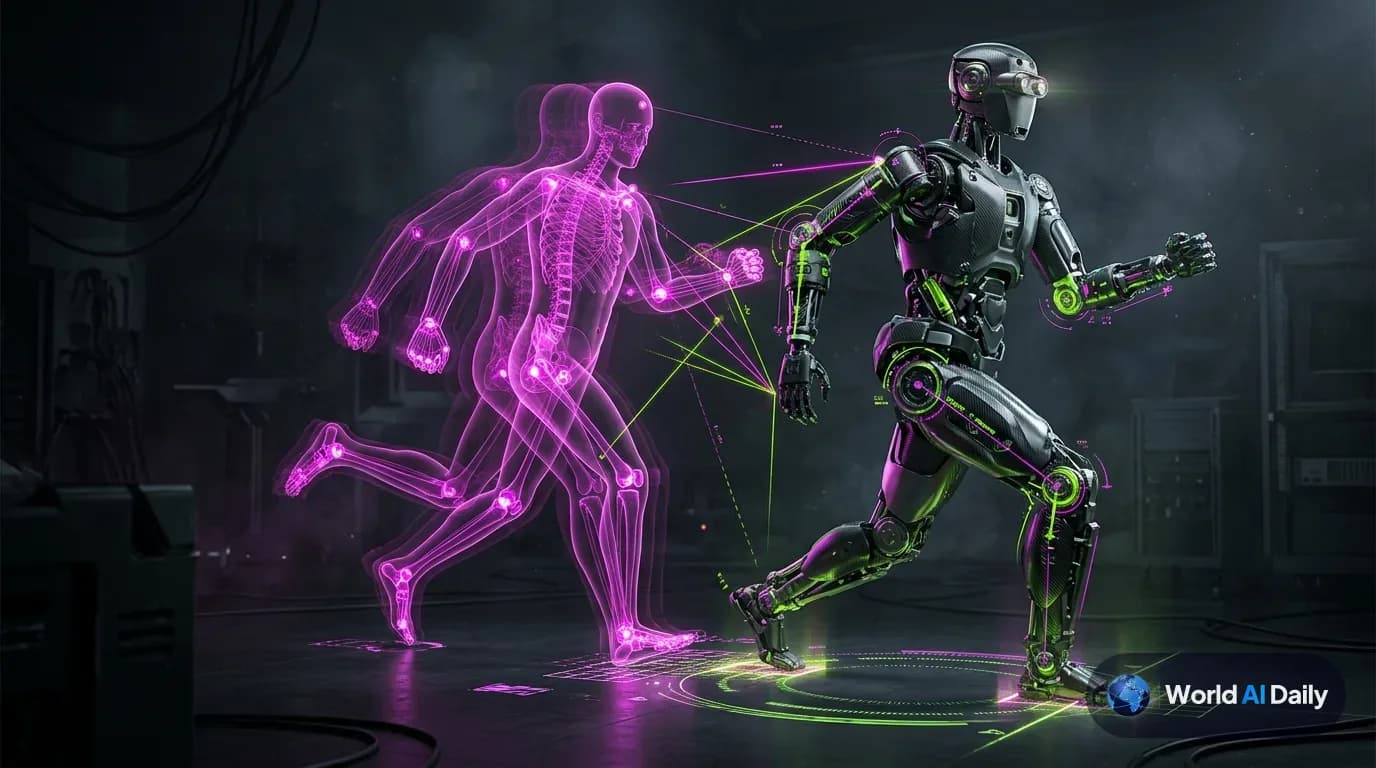
NVIDIA has released SOMA Retargeter, an open source tool that turns human motion data into joint trajectories for humanoid robots. The tool takes animation built on the shared SOMA skeleton and scales targets to the robot's proportions. It then solves inverse kinematics with Newton, which is built on NVIDIA Warp, and applies corrections such as foot-plant adjustment. Each output is a CSV file holding the robot's root pose and joint angles for every frame. Sources of human motion include the BONES-SEED motion-capture dataset, video reconstruction through GEM-X, and the generative models Kimodo and ARDY. Version 0.2 includes reference configurations and sample results for five robots: the Unitree G1 and H2, the Booster T1, and the AgiBot X2 Ultra and A3T3. A Robot Configurator and an experimental IK weight optimizer help tune the results, while batch retargeting covers larger motion collections. Retargeted trajectories can feed policy training in SONIC and ProtoMotions and then be tested in simulation. For animation and motion-capture teams, the tool offers a route from captured or generated performances into robotics.
Key facts
- SOMA Retargeter turns human motion data into joint trajectories for humanoid robots.
- Version 0.2 includes reference configurations for five robots, including the Unitree G1 and H2.
- Each output is a CSV file holding the robot's root pose and joint angles for every frame.
- Retargeted trajectories can feed policy training in SONIC and ProtoMotions before simulation testing.
AI-assisted summary Editorial standards