AWS shows how to split one GPU's memory across teams on EKS with NVIDIA's Run:ai
Reported by AWS
Original author: Muru Bhaskaran
Originally published: 19 Nov 2026, 21:43 IST On World AI Daily:
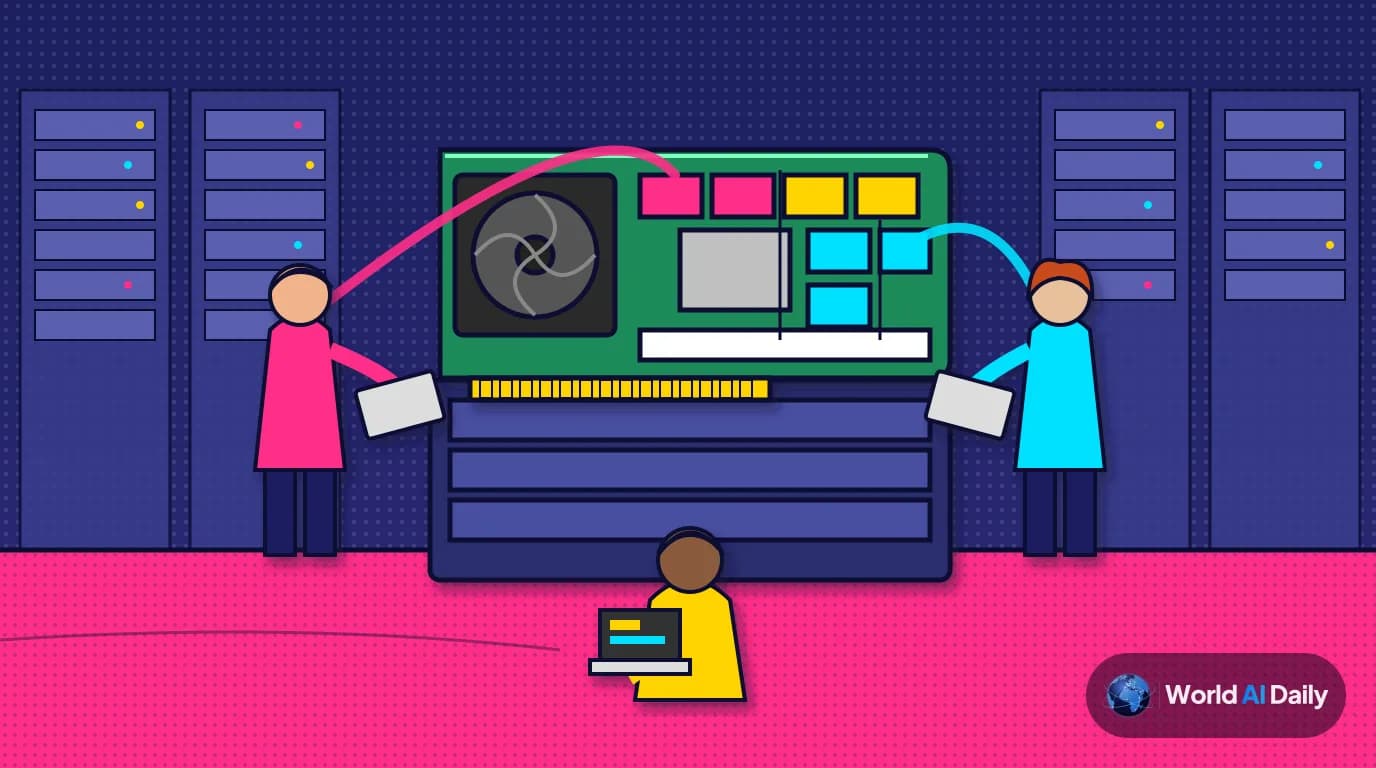
AWS has published a walkthrough for sharing a single GPU's memory among several teams on Amazon EKS, using NVIDIA Run:ai GPU Fractioning. NVIDIA open-sourced Run:ai on October 13, 2026. The example relies on two of the four components: the GPU Fractioning Operator and KAI Scheduler. It runs on a single EC2 g5.xlarge node with an NVIDIA A10G holding 23,028 MiB of memory. In the baseline, two Pods that each request a whole GPU cannot run together on that node, even when their combined memory needs would fit. Fractioning adds Kubernetes-aware scheduling, enforced memory limits for each Pod and per-Pod metrics. In the test, every Pod gets an 8 GiB contract and allocates 6 GiB, while a 9 GiB allocation is rejected. AWS says the guide does not test fault containment or compute performance, and the higher density does not establish better throughput or lower cost. The approach fits notebooks, short evaluations and small inference services on GPUs without MIG. The walkthrough also needs a custom Amazon Linux 2023 image, since the stock EKS image lacked the R615 driver branch when AWS tested.
Key facts
- AWS published a walkthrough for sharing one GPU's memory among several teams on Amazon EKS using NVIDIA Run:ai GPU Fractioning.
- The validated example runs on one g5.xlarge instance with an NVIDIA A10G holding 23,028 MiB of GPU memory.
- In the test, each Pod has an 8 GiB memory contract and allocates 6 GiB, while a 9 GiB allocation is rejected.
- AWS says the guide does not test fault containment or compute performance, and higher density does not establish better throughput or lower cost.
AI-assisted summary Editorial standards